

55A Morton Road, N1 3BG, London, United Kingdom
See what we’re up to on social.
Fresh tips, ideas and strategies for growing your business.


What is AEO?
AEO, or query optimisation as we sometimes call it, is a new website promotion method that focuses on providing precise answers to users. While traditional organic promotion (SEO) is based on keywords and broad phrases, query optimisation is based on providing precise answers that address search intent.
Even before the AI revolution, Google and other search engines tended to display what's professionally known as a "zero result". You're all familiar with this; it's the first thing you see in Google when searching for something, where the answer is simply displayed above all other results. This shift began the change in the world of organic promotion, but large language models (LLMs) delivered the final blow and forced marketers to develop a new method to ensure our websites appear in ChatGPT and other AI tools; thus, AEO was born.
The foundation of the method is simple - instead of simply identifying and collecting keywords that people search for, we invest effort in understanding the user's true intent. One of the greatest advantages of AEO is that it promotes our website both in regular search engines and in AI-powered search engines. This way, we ensure our website's presence across all platforms.
Why You Must Pay Attention to AEO
You're probably looking at what we've written so far and asking yourself, "How does this affect me? Why should I care about all this?" And you might be right in a sense because these are technical matters, but if you want your website to continue generating revenue, you should read the following paragraph.
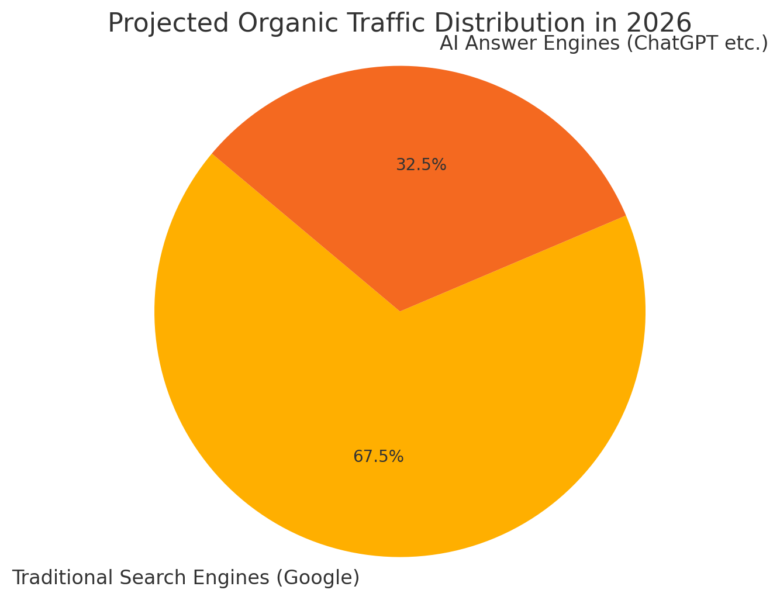
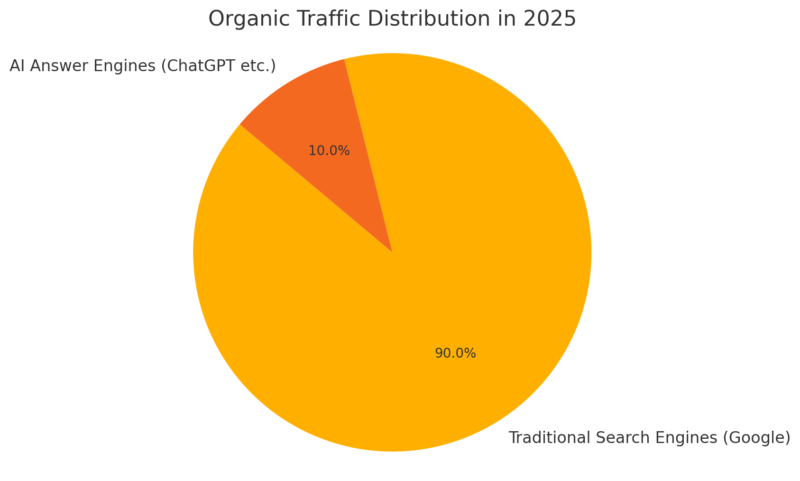
Currently, 92% of internet traffic originates from Google, but despite this, about 65% of Google searches do not end with the user clicking on any link. This means that the changes Google has made to its algorithm and search display cause users to simply get their answer at the top of the page and, as far as they're concerned, that's the end of the story. Add to this the fact that, according to all research, by 2026, Google will lose approximately 25% of its traffic to AI-powered search engines like ChatGPT.
The good news is that there's something we can do, and it's not even very difficult. Later in this guide, you'll find tips to help ensure your website enjoys both slices of the pie, but first let's understand the basics of query optimisation so you can see that you can already make some simple changes to your website and gain greater exposure for your content.
The Foundations of Query Optimisation
The field of AEO differs from the organic promotion we've known thanks to its focus on several key elements:
- Format of precise and concise answers
- Conversational writing style
- Adding Schema markup
In addition to these elements, it's recommended to use the rest of the content to provide value and, if necessary, use bullet points and informative, clear headings.
10 Tips That Will Put Your Website on Top
As we wrote earlier, the first and most important thing we need to do is understand user intent. This understanding will form the foundation of all our tips and everything we do from now on, but beyond that, it's important to note upfront that query optimisation (AEO) is not meant to replace organic promotion; it's only meant to strengthen it and encourage users to click and enter your site.
So let's not expand too much on words and get down to business:
Ensure Your Site Is Fast Enough
The foundation of any good website, regardless of anything else, is speed. We live at a fast pace, and no one has the patience to wait for a site to load. Just imagine the last time you tried to access an unfamiliar website and it took more than three seconds to open, did you wait, or did you go back and click on the next result?
Just as you don't wait, neither do crawlers and search engines, and if your site doesn't load quickly, they'll simply move on and deliver results from another site. There are many ways to ensure your site is fast enough -you can compress images, reduce the use of elements and plugins, and more. But the best way is to visit PageSpeed, scan your site, and get a full breakdown that includes actions you can take to improve your score.
Add Questions and Answers
As you've understood, the major shift in search methodology is primarily a move towards questions. People no longer search using keywords but rather in the form of questions and short sentences. If you once wanted to find a pizzeria in an unfamiliar place, you would probably have searched for "pizzeria Rome recommendations" or something similar. But nowadays, if you want to search for the same thing, you'll likely search for something more like "What's the best pizza in Rome?"
The more questions and answers you add to your website, the more questions you can answer and the greater the chance that Google and AI engines will pull results from your site. Try to incorporate questions and answers on every page and in every article, cover a wide range of topics, and ensure you always provide a clear and concise answer.
Write in a Simple and Accessible Manner
Another change that Google has begun to implement and which is receiving widespread attention in the world of artificial intelligence is the writing style. We won't go into all the details because it would take too much time, but for a long period, Google and search engines have been transitioning to what's called NLP, which basically means they better understand our writing and are adapted to understand everyday speech and conversation.
The more simply and clearly you write, use short paragraphs, and get to the point more quickly, the more both users and all the various algorithms will appreciate it. You no longer need to write million-word articles just to reach some quota; today, everything needs to be purposeful and without wasting time.
Use Schema
Schema tags are a special system that helps search engines understand exactly what content we've written. Using these tags, which are inserted into the HTML code, we tell the various systems whether the content is about questions and answers, event details, or anything else. Beyond Schema, ensure your site contains all the important elements to be indexed, such as Site Map, Robots.txt, and meta tags.
Keep Content Fresh
Sometimes, instead of writing a new article, it's better to update an existing one. AI engines tend to show users the newest results, not necessarily the highest quality ones. Some of the signals used by query engines are based on publication dates and the urgency of updates made to existing articles, so if you keep your content up-to-date, you'll increase the chances of being displayed.
Beyond query engines, this makes sense from an organic promotion perspective as well. If you have a quality article that brings consistent traffic to your site, why compete with yourself with another article on the topic when you can simply update the existing one and also benefit from the advantage provided by the page's seniority?
Pay Attention to Structure
The more you make it easier for users and search engines to understand your article, the more likely they are to actually try to read it. Using H1 and H2 headings, bullet points, and even tables all help divide the article in a clear and logical way, and along the way, they allow us to incorporate additional keywords.
Understand the Intent Behind the Search
This is perhaps the most important thing you can and should do to integrate into the new search world. Don't just settle for searching for what words people are looking for; try to understand the intent behind the search and what they want to achieve from the article they'll read. Use Google's "People Also Ask" option, think about synonyms that expand the topic or delve into specific details, and try genuinely to provide real value.
Adapt Your Content for Voice Searches
Although the trend of voice searches hasn't fully caught on in the country yet, just look at any 10-year-old child holding a mobile phone, and you'll see that the storm is just around the corner. The basic and most important thing to understand is that voice searches tend to be longer and more conversational than classic searches. For a voice search to use the information on our site, we need to identify long keywords that match natural conversation rather than robotic dialogue, and we need to keep one short and precise answer that is about 30 words on average.
Build an Authoritative and Professional Image
Like humans, robots also tend to trust authoritative and professional individuals more. The more we succeed in showcasing our experience and authority in our field on our website, the more search engines will trust us and answer based on the content we provide. To enhance what is professionally termed E-E-A-T, we need to provide evidence that we are certified professionals, but beyond that, we need to provide information not found elsewhere online and supplement existing knowledge in a deeper and more detailed manner.
Don't Settle for Words Alone
One characteristic of query engines like ChatGPT and AI-based search engines is their ability to understand and display rich content, not just text, but also images, videos, infographics, tables, and diagrams.
Incorporating relevant images with proper Alt descriptions not only enhances the user experience but also helps AI better understand your content. Infographics and data tables are an excellent way to present complex information in an accessible format, and more than artificial intelligence knowing how to appreciate it, research shows that users stay longer on pages that incorporate different types of media. And all this without mentioning that videos are currently the most consumed type of content, not articles.
Go Beyond Your Website
This is a bonus tip we hadn't planned to give, but if you've read this far, you deserve it. To ensure your answers reach the relevant people and don't just stay on your website, post them on professional forums, in Reddit rooms, create TikTok videos or Instagram Reels, and publish on platforms like Quora. The more exposure and shares a particular answer receives, the more likely it is that AI engines will recognise its authority and pull it in the future.
Invest in Understanding and Achieve Success
Even if you're not going to implement all the tips we've written in this guide, take one basic thing and invest time to understand what your users really want. Try to understand what they mean when they write something, invest in a quality experience and the added value you provide them, and implement this in the content you create. The rest will come on its own.
It's important to remember that promotion in the AI era is a completely new field, and although many present themselves as experts, the truth is that we're all still in the learning stages. No one can yet define themselves as a true expert in AI promotion, simply because the technology and algorithms are changing at a dizzying pace. At Alt, we conduct constant experiments to track changes, analyse how results behave in different tools, and gradually discover more and more parameters that influence the answers the systems display.
We at Alt are here to assist and help you promote your website in the best possible way. Using a combination of organic promotion methods with advanced AI tools, we analyse each situation individually and offer a tailored and precise solution. Our team consists of diverse professionals with proven experience in their fields who will join you on your journey. For more information and to schedule a meeting, you're welcome to visit our website or contact me directly.
Asaf Shimoni
Founder of Alt Digital Marketing, with nearly 20 years of experience in digital marketing. An expert in SEO and paid campaigns, helping tech companies, eCommerce, and B2B businesses achieve steady growth through tailored marketing strategies.

 Luch Web Design