

55A Morton Road, N1 3BG, London, United Kingdom
See what we’re up to on social.
Fresh tips, ideas and strategies for growing your business.


What is AI Overview?
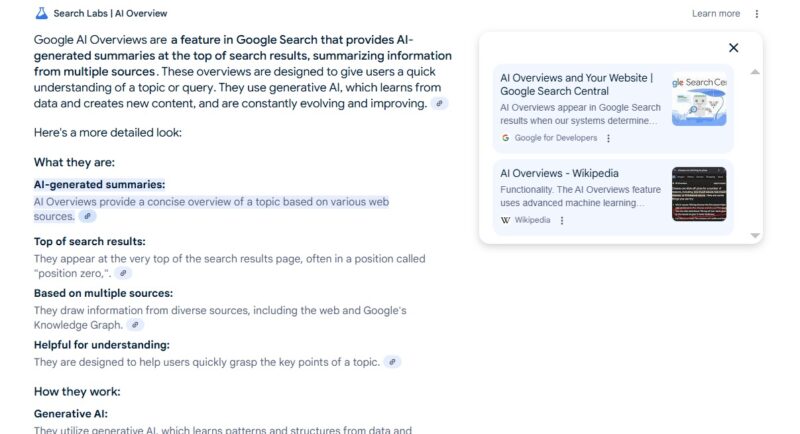
Google AI Overview is a response that Google's AI engine provides in reaction to any search query on Google. It's a dedicated integration of Google Search with Gemini, designed to provide users with an accurate answer based on high-quality and relevant articles.
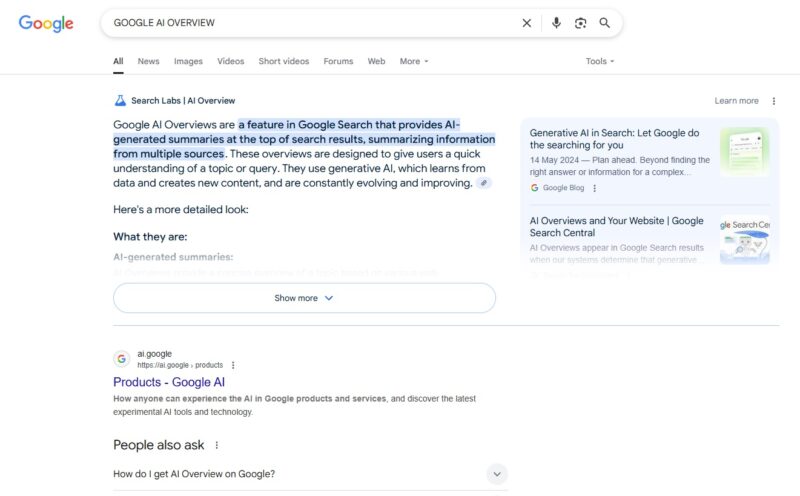
The Future of Google Search
Just like the featured snippet that Google launched several years ago, the goal of AI Overview is clear - to give users an immediate and clear answer without needing to browse through dozens of results. For us as content creators, SEO professionals, and business owners, this means one thing: the competition has moved up a gear.
To appear in Google's AI Overview, your content needs to meet several fundamental criteria: it must be clear, concise, authoritative, and current, but equally important - it must speak the language that Google and users expect.
What is Google Really Trying to Achieve with AI Overview?
Ostensibly, the launch of Google AI Overview was designed to streamline the search process. Users receive an immediate, processed answer backed by links without needing to click through or browse external websites.
This certainly sounds convenient, smart, and even progressive. However, upon closer inspection, a troubling question emerges - is Google helping users, or simply consolidating control over content? Instead of directing traffic to the websites where the information was created, Google builds an internal summary from it - sometimes without users even seeing where it originated.
One Answer - Instead of Dozens of Results
Previously, when you searched for "how to choose project management software", you would receive dozens of results of all types - comparison articles, blogs, guides, and more. Today, you get a single paragraph written by artificial intelligence containing the key points, and in most cases, it doesn't require you to click through to any website.
This may save time, but it also blocks access to different opinions, in-depth comparisons, and information that hasn't passed through Google's algorithmic filter. As Google provides more information within its own platform, we - website owners and writers - risk becoming silent suppliers of information. We write, rank, build links, improve speed, and in the end, if we're lucky, we might appear in AI Overview without clicks, without traffic, without visible credit.
To understand how to appear in AI Overview, it's important to first understand the real motivation behind it. Google wants to keep users within its system for as long as possible, with as few external exits as possible. The conclusion? To "play the game", you need to understand both the rules and the interests of those who set them.
Why Google Added AI Overview
The Story Behind the Feature - and How It Feels in Practice
Behind the scenes of Google AI Overview's launch lies a change that has sent shockwaves through the organic search industry. This isn't just about a new algorithm, but a shift in Google's perception of what search is and what place content websites have within it.
Several content creators and SEO professionals we've spoken to report:
"Suddenly, an entire article we'd invested weeks in appears in AIO as a single paragraph, without a click."
"Our guide appeared in Overview but hardly any visitors came through. All the information was already in the summary."
"We're seeing pages with high visibility but zero actual traffic. It's frustrating."
So How Does This Actually Affect Websites?
Decreased CTR: Even websites that rank highly are finding that being in first position no longer guarantees clicks.
Increase in zero-click searches: Users get their answer and don't continue browsing.
Source obscurity: Often, users don't know which website the information came from.
In other words: visibility doesn't necessarily equal traffic. SEO professionals and organic search specialists worldwide have already realised that even when they succeed in getting into AI Overview, it feels like a "hollow victory". The content is displayed, but without context, without brand name, and without the user interaction we've built over years.
To properly deal with this change, we must look at it eye-to-eye - without euphoria and without panic. The next section will attempt to answer the strategic question: how much is it really worth investing in trying to appear in Google AI Overview?
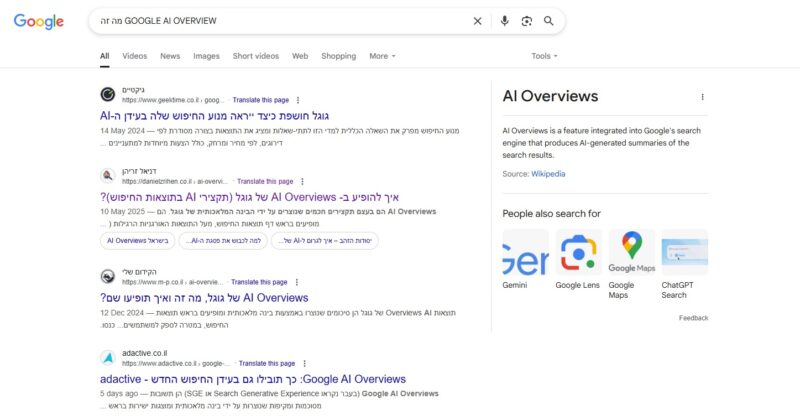
How Much Should You Invest to Appear in AI Overview?
Everyone should aim to appear in AI Overview simply because that's where the future of search results lies. Overview results are going to occupy a significant portion of the first page in Google and directly impact your ability to attract quality organic traffic. Investing in getting AI Overview to draw information from your website doesn't conflict with the need to also appear in traditional search results - on the contrary, it complements them.
To determine how much you should invest in each page and each keyword, you can perform a simple assessment by examining the following elements:
Does the Page Provide Unique Value?
If you're presenting generic information that's also available on competitor websites, Google can "cut" a paragraph from it and display it without explicitly mentioning you or displaying you among the first results. However, if you're bringing first-hand information, personal experience, or analysis that doesn't appear anywhere else, there's a high chance Google will not only display you but encourage visits to the full page.
Is This a Commercial Intent Query?
If you're targeting a purely informational query like "how to build a wooden fence yourself", the chance of appearing in Google's AI Overview is high - but so is the chance that users will get all the information directly from Google without clicking through to your site.
In contrast, for queries with clear purchase intent, such as "wooden fence pricing 2025", Google tends not to display AI Overview. In such cases, where users are looking for services or products, they tend to click on results to compare, read reviews, or take action.
Is This Actually an Important Page or a Peripheral One?
Not every page should target AIO. For example, pages designed to convert visitors into customers, make purchases, or generate contact shouldn't necessarily appear there. Conversely, brand articles, practical guides, and answers to complex questions can be much better candidates.
Not every page on your site needs to appear in Google's summary because our goal isn't just to appear, but to attract readers to enter, read, and stay on our site. Invest your resources in content that will benefit from appearing in AIO.
Checklist: How to Appear in Google's AI Overviews
For Google to choose your website as a source for AI Overview, it's not enough for the content to just be good - it must be accessible, clear, authoritative, and structured in a way that allows artificial intelligence to easily "extract" the answer from it.
Here are the key steps:
Step 1: Write How Google Searches
- Phrase subheadings as natural questions (e.g., "How does it work?", "What are the benefits?", "What's the difference between X and Y?").
- Answer concisely at the beginning of the paragraph - one or two sentences, clear and to the point.
- Break down information into lists, tables, or steps - especially when dealing with processes.
Step 2: Position Yourself as a Trusted Source
- Add credentials: Include the author's name, professional background, and credible profile page in the article.
- Include external sources: Research, updated data, standards.
- Write in a neutral tone: Google isn't looking for articles with superlatives ("the best"), but those that present information and facts.
Step 3: Use Structured Data and Formats That "AI Understands"
- Add appropriate schema: (FAQPage, HowTo, Article).
- Use bold for key words.
- Maintain proper heading hierarchy (H1 → H2 → H3).

Step 4: Update Content and Highlight What's New
- Include an update date at the top of the page.
- Incorporate current information for 2025.
- Add new questions that come up in Google, especially in the "People Also Ask" section.
Step 5: Build Links and Expand Online Presence
- Answer professional questions in forums: such as Reddit, Quora.
- Try to get mentions on relevant news sites/blogs.
- Strengthen personal or business branding at every opportunity.
Step 6: Monitor Actual Appearances
- Use Google Search Console to check which pages are ranking.
- Activate GTM (Google Tag Manager) to track links with ::text= appearing from AI Overview.
- Monitor changes in CTR and dwell time on important pages.
What Google Doesn't Tell You - But You Should Know
While Google provides official documentation (Search Essentials, AI Overview Guidelines), in practice, much of what determines whether you appear or not happens outside the lines of the guide they've published on the subject.
Here are some insights that have emerged in the field, which may change how you write content:
Google Checks How Users React to Results in Real Time
If users click on "Show More" and then "Show All" in AI Overview, the algorithm changes the order of links. In other words, user clicks and actions directly affect your chances of staying in the box or disappearing. This means that if your content appears but doesn't attract clicks, it will drop in ranking even within the AIO.
Appearing at #5 Can Become #1 or Disappear Entirely
Unlike regular SEO, where position is determined by relatively stable rankings, in AIO your result can move from one extreme to another based on user behaviour. For example:
- Quick click = ranking improvement
- Lack of interaction = decline
- Opening expansion = dramatic change in source order
Not All Pages on Your Site Need to Fit AI Overview
Google doesn't display AI Overview for every query, but mainly for informational, complex queries, or those involving multi-step reasoning. In other words: there's no point in killing yourself to change content on product pages, contact pages, or purchase pages - but rather focus on guides, in-depth articles, and answers to popular questions.
Content That Looks Like AI Gets Rejected by AI
Yes, you read that correctly. If your content looks like it was written by ChatGPT and built from fixed templates without providing added value, there's a chance it won't be selected as a relevant link for Google AI Overview. According to recent studies (including from Search Engine Journal), websites that used generic AI-based content experienced a sharp decline of 60%-75% in traffic in the period after AI Overview's launch.
There's a Tendency to Choose Different Sources
Google's algorithm looks for diversity in source types, tone, and angles. Therefore, content that looks like everything else simply won't be chosen. Conversely, an article that offers an original perspective, different style, or concrete first-hand information will stand out and be selected.

FAQ: Google AI Overview
How Do You Appear in Google's AI Overview?
To appear, your website needs to rank highly in Google, be trustworthy (E-E-A-T), and provide clear, current answers to questions users actually ask. Google draws content from sources it identifies as accurate, authoritative, and machine-readable.
Do You Need to Submit Your Site to Google to Be Included in AI Overview?
No. Inclusion in AI Overview happens automatically based on Google's algorithms. However, it's advisable to ensure your site is crawled, indexed, and updated through Google Search Console.
What Are Google's Main Criteria for Selecting Sources for AI Overview?
- Understanding user search intent
- Clear structure (question/answer headings, lists, tables)
- Current and accurate content
- Authority (expertise, external sources, professional writing)
- Positive user experience (speed, readability, mobile compatibility)
Does Appearing in AI Overview Guarantee Traffic to Your Site?
Not necessarily. Sometimes users get the complete answer without clicking through. However, if you appear as the first link and spark curiosity, there's a high chance of receiving quality traffic with higher engagement.
How Can You Track AI Overview Appearances?
- Using tools like Ahrefs and SEMRush (which mark AIO appearances)
- Through Google Analytics 4 + GTM (tracking entries from text fragments)
- Through indirect measurement: CTR changes, traffic increases/decreases to specific pages, etc.
Is It Worth Investing in Writing Tailored for AI Overview?
Yes - if your goal is to appear in informational queries, build authority, and strengthen your brand as a knowledge source in your field. Especially if it's content at the top of the funnel (beginning of the user journey).
Can You Request Not to Appear There?
Yes. You can use tags like nosnippet or data-nosnippet, but there's a cost: it will also prevent your page from appearing in regular Featured Snippets and harm your overall visibility in search results.
Asaf Shimoni
Founder of Alt Digital Marketing, with nearly 20 years of experience in digital marketing. An expert in SEO and paid campaigns, helping tech companies, eCommerce, and B2B businesses achieve steady growth through tailored marketing strategies.

 Luch Web Design